


I. Real-World Challenges in Biopharmaceutical Aseptic Filling
Aseptic filling in biopharmaceutical manufacturing presents three long-standing operational bottlenecks that require continuous industry focus:
Aseptic Boundary Limits: Any trace contamination during the filling process can lead to the loss of an entire batch. This places exceptionally high demands on equipment sealing design, material selection, and environmental controls.
Micro-Dosing Precision: Small-volume liquid fills 1ml to 20ml operate under stringent tolerance margins. If stoppering yield falls short, it directly compromises product recovery and batch-to-batch consistency.
Format Changeover Costs: Traditional filling lines are built for dedicated containers. Accommodating multiple formats-such as pre-filled syringes (PFS), cartridges, and vials-typically requires purchasing separate machines, escalating capital expenditure and consuming high-cost cleanroom footprint.
To address these universal challenges, Shanghai ALWELL Machinery Equipment Co., Ltd. developed the Nest/Tub RTU Vacuum Filling Machine. Designed for sterile syringe filling, the platform resolves these issues through optimized structural design and innovative process routing.
II. Product Positioning and Value Proposition
The Nest/Tub RTU Vacuum Filling Machine is engineered as a highly adaptable, integrated vacuum filling platform. It specifically targets common bottlenecks in small-dose biopharmaceutical aseptic filling, such as persistent air bubble entrapment, limited container compatibility, and excessive cleanroom footprint.
The machine delivers three distinct operational value propositions:
Lower Capital and Maintenance Expenditures: A single platform seamlessly transitions across various Ready-To-Use (RTU) formats-including pre-filled syringes, cartridges, and vials-reducing overall machinery procurement needs.
Guaranteed Product Recovery and Consistency: Dynamic testing demonstrates filling accuracy within ±1%, alongside a stoppering success rate exceeding 99.9%.
Reduced Infrastructure and Cleanroom Costs: A compact, modular layout minimizes machine footprint, freeing up valuable cleanroom space.
III. Key Technical Architecture
The equipment's functional modules are engineered around two core imperatives: sterility assurance and dosing precision.
Full Servo-Drive System: Ensures precise station synchronization, maximizing line stability during high-speed runs.
Vacuum Sealing Module & Two-Stage Elevation Mechanism: Addresses air entrapment by performing fluid dosing under negative pressure. This mechanism eliminates residual air gaps and bubble formation within the syringe barrel.
Intelligent Control Interface: Features a Siemens high-definition touchscreen coupled with a Schneider PLC control platform, streamlining operator training while enabling real-time parameter monitoring and full batch data traceability.
Sanitary Material Selection: Fluid-contact components are crafted from 316L stainless steel and medical-grade silicone to prevent extractable/leachable migration or product absorption, meeting high-grade aseptic surface specifications.
IV. Core Performance Metrics
Based on empirical factory test data, the vacuum filling machine achieves a throughput of 1,500 to 11,000 units per hour, making it suitable for applications ranging from R&D pilot batches to commercial-scale manufacturing.
Dosing accuracy is consistently maintained within ±1%, while the stoppering yield reaches 99.9%. These figures demonstrate a balanced synergy between operational throughput and fill-finish precision, serving as a benchmark for evaluating aseptic syringe filling equipment.
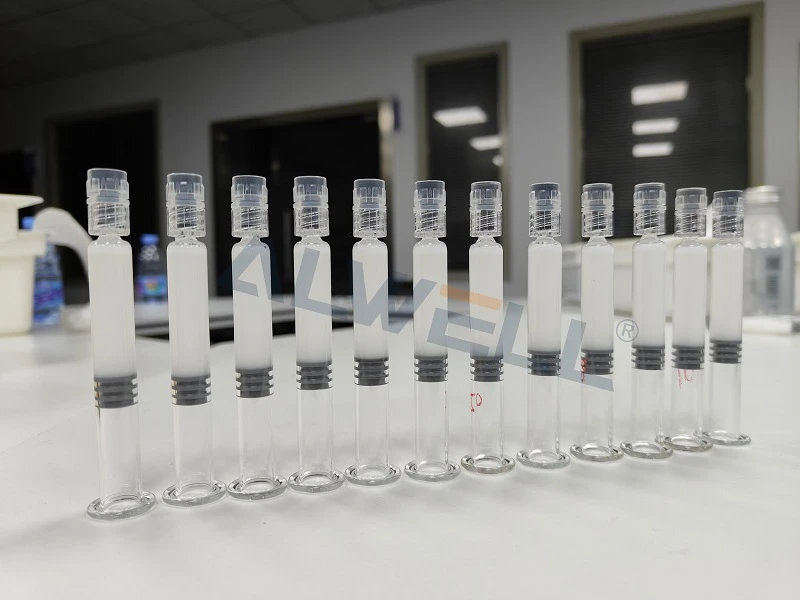
V. Certifications, Intellectual Property, and Engineering Support
To support compliance and technical validation, key design elements of this platform are protected under utility model patent "A Bubble-Free Vacuum Syringe Filling Machine" (Application Date: February 1, 2024). Shanghai ALWELL Machinery holds ISO9001 Quality Management System certification and European CE conformity, establishing a verified foundation for quality assurance and international market entry.
The product line is backed by a cross-functional technical team specializing in mechanical engineering, industrial automation, and aseptic process validation. Utilizing advanced design tools (SolidWorks, AutoCAD) and custom software development across Schneider and Siemens platforms, the engineering group delivers complete turn-key line planning and integration. The team's technical ladder spans mid-level engineers, senior staff engineers, and technical directors.
VI. Delivery Models and Downstream Integration Capabilities
To accommodate varying facility scales and production strategies, the system is offered under two delivery models: standalone equipment supply or customized, end-to-end line integration.
To create a fully automated closed-loop workflow, the core platform integrates with downstream auxiliary units:
Automated Visual Inspection Systems (AVI): Utilize advanced computer vision algorithms to detect foreign particulate matter and container-closure cosmetic defects, minimizing manual handling and contamination risks.
Plunger Rod Insertion and Labeling Systems: Automatically assemble plunger rods and apply labels in-line, ensuring smooth integration with the main filling unit.
VII. Conclusion
By specializing in Vacuum Filling Machine. technology and RTU container compatibility, Shanghai ALWELL Machinery Equipment Co., Ltd. addresses core industry pain points surrounding sterility assurance, micro-dosing precision, and container changeover costs.
With a global footprint spanning Europe, the Americas, the Middle East, and Southeast Asia, the company delivers cost-effective, rapidly customized, and timely domestic equipment solutions for biopharmaceutical manufacturers evaluating aseptic fill-finish machinery.