


Small-volume aseptic filling - doses of roughly 0.1 ml to 20 ml in prefilled syringes, cartridges and vials - fails on five predictable vectors. Retained gas bubbles compromise batch uniformity. Metal pump seals wear, so metering accuracy drifts and calibration becomes routine. High-viscosity formulations bubble, stall or under-fill. Pneumatic control responds in 200–500 milliseconds, which is coarse for microlitre work. And the lifecycle costs of validation, changeover and cleanroom footprint stay hidden behind the initial quotation. Solving these one at a time produces a line that is compliant but commercially slow. This guide shows how ready-to-use (RTU) vacuum filling and stoppering, ceramic plunger metering and full-servo motion control address all five together - with the operating figures you need to write a specification: −0.06 to −0.09 MPa chamber vacuum, 0.1–20 ml fill range, ±1% accuracy, above 99.9% stoppering pass rate, sub-10 ms servo response and 30-minute changeover.
Why small-volume aseptic filling fails in practice
The constraints below are not independent. A bubble problem is usually also a metering problem, and a metering problem is usually a control-loop problem. Treating them as separate purchasing decisions is what produces lines that pass FAT and then underperform in commercial production.
| Constraint | Mechanism | Commercial consequence |
|---|---|---|
| Retained gas | Dissolved and entrained air stays in the formulation after filling | Cosmetic rejects, variable dose, batch consistency complaints |
| Pump seal wear | Elastomer seals in metal piston pumps abrade against the cylinder | Progressive accuracy drift, frequent recalibration and spare-part spend |
| Viscous flow behaviour | High-viscosity and shear-sensitive materials resist uniform delivery | Bubbles, flow interruption, incomplete fills, reduced uniformity |
| Control latency | Pneumatic actuation typically responds in 200–500 ms | Overshoot and undershoot that microlitre doses cannot absorb |
| Validation load | DQ/IQ/OQ/PQ cycles are long and expensive per equipment variant | Slow time-to-market, high cost per additional packaging format |
| Packaging proliferation | A single-format line per container type | Duplicate equipment purchases and wasted cleanroom floor area |
| Hidden lifecycle cost | Validation, maintenance and changeover are excluded from the quotation | Total cost of ownership diverges sharply from purchase price |
The last two deserve emphasis because they are the ones buyers most often discover too late. Cleanroom space is the most expensive square metre in the building, and every additional single-format machine consumes it permanently. The same logic applies to validation: a platform that covers several container types shares one validation backbone, whereas three dedicated machines require three.
What ready-to-use packaging changes on the line
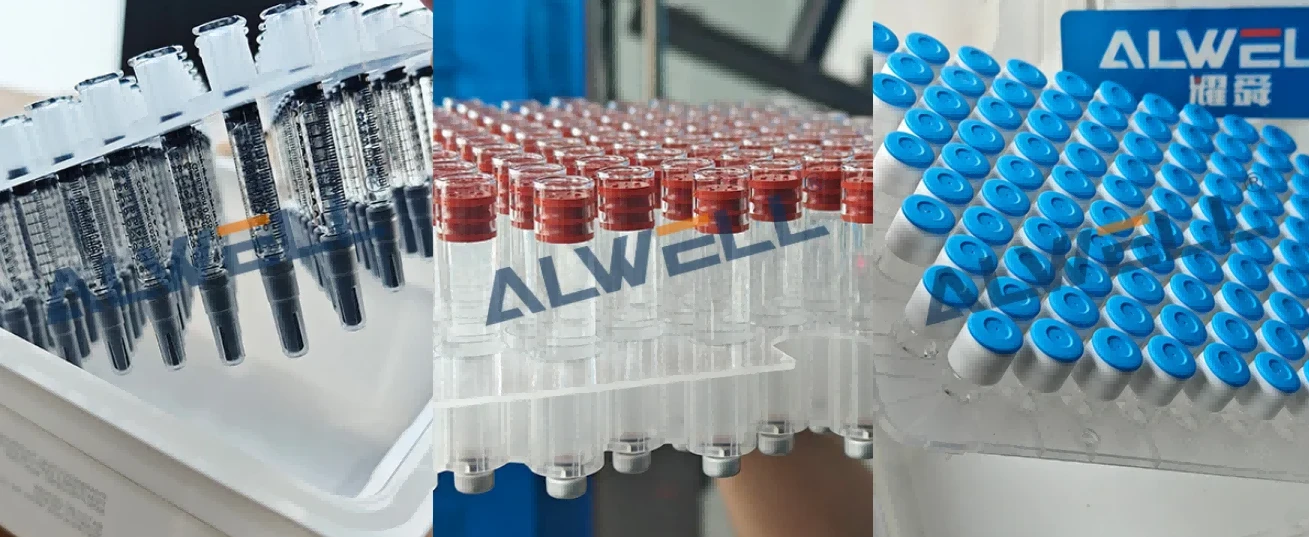
Ready-to-use packaging arrives pre-sterilised and pre-assembled in nested tubs - syringes with or without needles, cartridges, or vials - so the aseptic core no longer needs a washing tunnel, a depyrogenation tunnel or a glass-handling conveyor. That removes particulate sources and breakage from the critical zone, and it shortens the distance between the nest and the filling needles.
It also changes what the machine must be good at. Nest and tub handling replaces container handling: tub transfer, nest lift, needle insertion through the nest septum, and re-nesting after stoppering all become the accuracy-critical motions. A RTU line therefore lives or dies on positional repeatability, not on conveyor speed. That is why the specification that matters is servo repeat positioning - on the platform described here, ±0.01 mm - rather than maximum theoretical throughput.
The commercial benefit is format coverage. A single RTU platform can be adapted to prefilled syringes, cartridges and vials by changing specification parts, which is the difference between one capital purchase and three. See the RTU nest-type filling and stoppering machine for the platform configuration and the prefilled syringe filling series for format-specific variants.
How vacuum filling and stoppering removes dissolved gas
The gas–liquid interface principle
Before filling, the machine draws the filling chamber down to a negative pressure of −0.06 to −0.09 MPa. At that pressure the solubility of dissolved gas in the formulation falls sharply, and gas migrates out of solution toward the gas–liquid interface, where the pressure differential drives it off. The formulation is metered and delivered while still under vacuum, so the dose enters the container already degassed rather than carrying air that will later coalesce into a visible bubble.
This is a different mechanism from defoaming. Defoaming addresses foam that already exists at the surface; vacuum degassing prevents the gas from remaining in the bulk liquid in the first place. For high-value formulations where every rejected unit is a material loss, that distinction is the whole argument.
Why stoppering under vacuum matters
Stoppering is completed inside the same vacuum envelope, immediately after the fill. Two things follow. First, the stopper is seated while the chamber is still evacuated, so the closure is drawn into position and seats against the container wall with a tight, uniform fit. Second, the interval during which the drug solution is exposed to the surrounding environment is reduced to the minimum the mechanics allow - the container is never open to atmosphere between fill and seal.
The platform reports a stoppering pass rate above 99.9%, with fill accuracy held within ±1% across a 0.1–20 ml range using ceramic plunger pumps. Full-servo control keeps the response inside 10 ms, and the aseptic core runs under a Class 100 laminar flow hood with a sterile operating glovebox. For a deeper treatment of the closure mechanics, see vacuum stoppering technology.
Metering accuracy: ceramic plunger pumps versus pneumatic dosing
Pump choice determines whether accuracy is a design property or a maintenance task. Pneumatic dosing is attractive on price and simple to integrate, but its actuation latency is measured in hundreds of milliseconds, and its accuracy depends on seal condition that degrades with every stroke. A ceramic plunger pump changes both variables: the plunger and liner are hard, dimensionally stable and resistant to the abrasion that wears elastomer seals, and the displacement is driven by a servo axis whose position is known rather than inferred from air pressure.
| Parameter | Pneumatic dosing | Servo-driven ceramic plunger pump |
|---|---|---|
| Actuation response | Typically 200–500 ms | Under 10 ms |
| Accuracy basis | Pressure and time, seal-dependent | Positive displacement, mechanically fixed |
| Wear behaviour | Seal abrasion causes progressive drift | Ceramic-on-ceramic, dimensionally stable |
| Calibration burden | Frequent recalibration and seal replacement | Calibration interval set by validation, not by wear |
| Fill range demonstrated | Narrow, formulation-dependent | 0.1–20 ml on one platform |
| Achievable accuracy | Degrades between services | ±1% maintained |
The practical consequence is that a ceramic plunger platform removes calibration from the recurring maintenance calendar and moves it into the validation protocol, where it belongs. If you are already fighting drift on an existing line, the diagnostic sequence in filling accuracy calibration is the place to start before considering replacement.
Choosing capacity: 2-head, 5-head or 10-head cartridge filling
Capacity decisions should follow the clinical and commercial stage, not the maximum number on the datasheet. A ten-head machine installed for a Phase II batch is capital that earns nothing for three years; a two-head machine specified for launch volumes becomes the bottleneck that forces a second purchase.
| Configuration | Footprint and weight | Output | Typical application |
|---|---|---|---|
| 2-head | Approx. 2,200 × 1,000 × 2,400 mm including laminar flow; approx. 500 kg | 1,500 units/hour | R&D and clinical trial supply; insulin producers and smaller manufacturers with constrained budgets |
| 5-head (e.g. CHS-5-11 insulin cartridge line) | Single machine, integrates downstream | 4,000 to over 11,000 units/hour | Scale-up and commercial launch; connects to visual inspection, sterilisation and tray loading, rod insertion, labelling, checkweighing and pillow packaging |
| 10-head | Single machine, multi-channel | Scales with channel count | High-volume commercial production; individual channel adjustment and fault isolation so one stopped channel does not halt the rest |
The 10-head configuration is worth understanding as an availability decision rather than a throughput one. Because each channel is independently adjustable and fault-isolated, an abnormal stop on one lane removes that lane's output from the batch while the remaining channels keep producing. On a monolithic high-speed line, the same fault stops everything. For the full selection logic across the range, see cartridge insulin filling from 2-head to 10-head.
The fully automatic prefilled vacuum filling and stoppering machine runs the whole sequence unmanned - automatic tube loading, centrifugal tube arranging, siliconisation, filling, stoppering and cap tightening. The double-head model produces 1,200–1,400 units per hour; multi-head RTU configurations reach 11,000 units per hour.
High-viscosity and cross-linked formulations
Hyaluronic acid, cross-linked HA, sodium hyaluronate, chitosan, plant protein and peptide solutions share a property that breaks conventional filling: apparent viscosity that changes with shear rate, so the material behaves differently in the reservoir, in the transfer path and at the needle. Fill a shear-thinning gel with a dosing profile designed for water and you get bubbles at the inlet, stringing at the nozzle, and doses that vary with residence time.
The design response is upstream of the pump. Reservoir geometry and the conveying path are configured to keep the material moving without entraining air, and to drain without leaving residue in dead zones - residue that is both a yield loss and a cleaning burden when the material costs more per gram than the machine's hourly rate. Vacuum filling then removes the gas that shear introduced, rather than trying to vent it after the fact.
Two formats cover this territory: the high-viscosity vacuum filling machine with full servo control and a high-precision ceramic plunger pump, and the sodium hyaluronate vacuum filling machine, whose storage and conveying structure is optimised for high-viscosity injectables - launched in 2025 for the medical aesthetics segment. The prefilled syringe vacuum filling and stoppering machine for these materials runs at 700–1,400 units per hour, completing fill and stopper under vacuum to match the slower rhythm that viscous products demand. A cross-linked hyaluronic acid line delivered to Brazil illustrates the configuration in production: cross-linked HA automated vacuum PFS filling line.
Changeover, cleanroom footprint and lifecycle cost
Changeover is where a flexible platform earns its premium. A modular adaptive changeover structure brings format changeover down to about 30 minutes, which is what makes multi-product small-batch production viable on the same asset as large-volume runs. Without it, the line is economic at one SKU and idle at three.
Footprint follows from the same architecture. Because the platform accepts syringe, cartridge and vial formats through specification parts rather than separate machines, the cleanroom houses one aseptic core instead of three, and the space that would have been a second and third filling room stays available for something that generates revenue. Equipment surfaces are electropolished, leaving no cleaning dead spots - a detail that matters more to your cleaning validation than to your maintenance team.
Lifecycle cost is the part of the quotation that is never in the quotation. Validation effort scales with the number of distinct machines, maintenance scales with the number of wear parts, and changeover labour scales with format complexity. Before shipment, equipment completes a continuous 72-hour full-load trial run and an inspection report is generated and archived - documented evidence that the performance figures were achieved on the actual unit, not only on a reference machine. That record is directly useful in your own qualification file.
Building the full line
A filling machine is rarely the whole line. Downstream, the syringe plunger rod insertion and labelling machine performs rod mounting, rod twisting, labelling and inkjet or laser coding in one pass; the light inspection machine provides visual inspection of filled units; and the loader handles transfer between stages. Connecting these to the filler produces an automated line rather than a set of islands.
For specific dosage forms, dedicated lines are available: a prefilled catheter flush syringe filling line and a vial aseptic filling line for liquid, powder and freeze-dried formats. Both comply with GMP requirements and hold EU CE certification. On the fully automatic prefilled syringe vacuum filling line, electropolished surfaces and Class 100 laminar flow over the entire automatic run path are specified for high-barrier sterile formulations. A fully automatic high-speed syringe filling machine was exported to Brazil in 2025, which is the delivery capability claim that a purchase order actually tests.
If your line involves automating existing manual steps rather than replacing the filler, the staged approach in automation upgrades for syringe filling lines is a lower-risk entry point.
Specification checklist before you request a quotation
Bring these to the conversation and the quotation becomes comparable across suppliers:
Fill volume range and dose increments - state the smallest and largest dose, not the nominal one. A platform covering 0.1–20 ml removes the need for a second machine later.
Formulation rheology - viscosity at the relevant shear rate, shear sensitivity, solids or microspheres, and whether the material is oxygen- or light-sensitive.
Container format and RTU status - syringe with or without needle, cartridge, or vial; nested or bulk; and whether you intend to add formats within 24 months.
Required output, realistically - units per hour at your actual batch pattern, including changeover and cleaning downtime, not peak datasheet throughput.
Accuracy and pass-rate acceptance criteria - written as the number your QA function will sign, with the sampling plan that proves it.
Vacuum specification - chamber pressure range and the degassing hold time needed for your formulation.
Cleanroom grade and available footprint - including height for laminar flow, and the services you can bring to the machine.
Validation deliverables - DQ/IQ/OQ/PQ support scope, factory acceptance test protocol, and whether a full-load trial run report is supplied.
Changeover target - minutes per format change, and who performs it.
Documentation and certification set - CE, ISO 9001, ISO 13485, GMP compliance statements, and certificate numbers for your own supplier qualification file.
Frequently asked questions
What fill volume range can a vacuum filling and stoppering platform handle?
The platform described here covers 0.1 ml to 20 ml with accuracy held within ±1%, using ceramic plunger pumps. Because displacement is mechanically fixed rather than pressure-derived, the same pump family covers the full range without a change of metering principle.
Can vacuum filling be used with highly viscous materials such as cross-linked hyaluronic acid?
Yes, and it is where vacuum degassing matters most. Shear introduced during transfer generates entrained gas in viscous and shear-thinning materials; drawing the chamber to −0.06 to −0.09 MPa before metering removes it at the gas–liquid interface instead of leaving it to appear as a bubble after sealing. Reservoir and conveying geometry are configured for high-viscosity products to limit residue and protect yield.
Can one machine fill syringes, cartridges and vials?
On an RTU platform, yes - formats are switched by changing specification parts, which is the basis for avoiding duplicate equipment investment and reclaiming cleanroom space. Confirm the specific format set and changeover time with the supplier against your 24-month product roadmap.
How long does a format changeover take?
About 30 minutes on a modular adaptive changeover structure. Verify this figure on your own format pair during the factory acceptance test, because changeover time depends on how far apart the two formats are.
What documentation supports validation?
Equipment completes a continuous 72-hour full-load trial run before shipment, and the resulting inspection report is archived and available for the customer's qualification file. Design and production comply with GMP requirements, and the company holds EU CE certification, ISO 9001 (2015) and ISO 13485 quality management system certification, with High-Tech Enterprise recognition since 2020.
Next step
Shanghai ALWELL Machinery Equipment Co., Ltd. has built small-dose aseptic filling equipment in Shanghai since 2013. The company manufactures on CNC machining centres - a capability adopted in 2014 and still the basis for the dimensional consistency that ceramic plunger metering depends on - and since the 2025 expansion operates from a 5,000 m² facility in Songjiang, supplying syringe, vial and cartridge filling solutions to customers across Europe, Southeast Asia, the Middle East, Africa, South America and North America.
Support continues past delivery. FAT and SAT are supported directly, with on-site installation, commissioning and operator training, followed by long-term maintenance and spare-parts supply - the part of the relationship that determines whether the changeover and accuracy figures quoted above still hold in year five.
If you are specifying a small-volume aseptic filling line, send your fill range, formulation rheology and container formats through the contact page - a configuration proposal and capacity calculation can be prepared against your actual batch pattern rather than a generic datasheet. Where a format decision is still open, a short technical review against the specification checklist above will usually resolve it faster than a quotation round.