


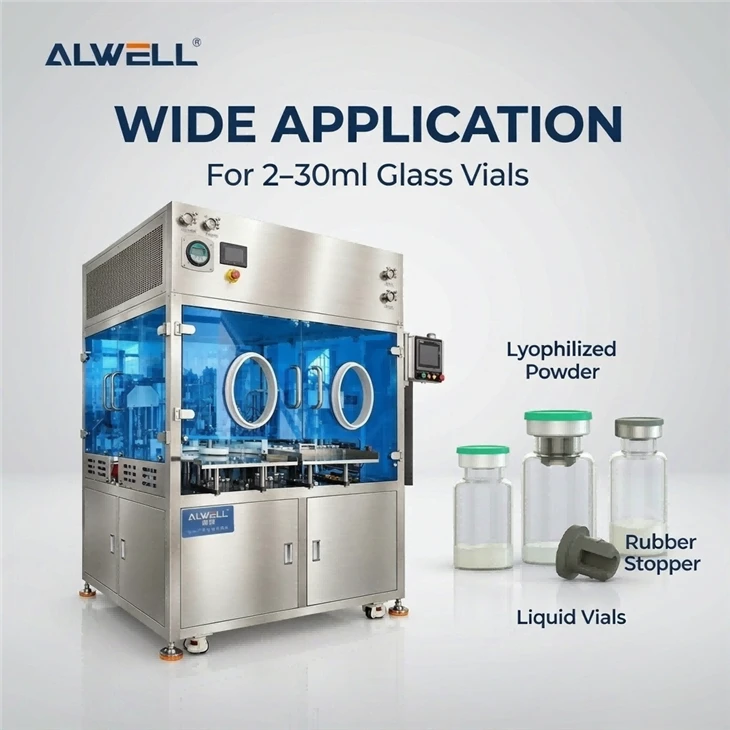


vial filling and sealing machine
is a special equipment developed by our company for aseptic filling
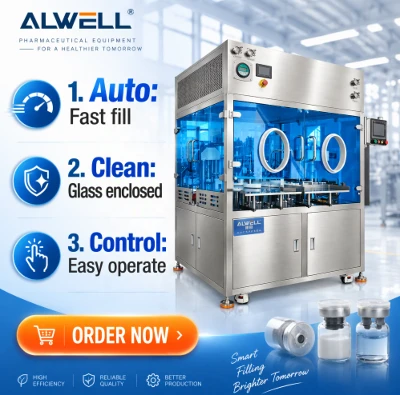
ALWELL's Vial Filling and Sealing Machine
ALWELL's Vial Filling and Sealing Machine is designed for aseptic filling and stoppering of pharmaceutical vials, with optional capping to complete the sealing process. It supports liquid and powder filling, with customizable filling heads and configurations to meet different production requirements. With servo-controlled operation, precise dosing and integration options for upstream and downstream equipment, the machine provides a flexible solution for pharmaceutical and biopharmaceutical manufacturers.
Products Overview
Vial Filling and Sealing Machine for Pharmaceutical Production
The ALWELL vial filling and sealing machine is an aseptic filling and stoppering system developed for pharmaceutical and biopharmaceutical production of injectable products. The machine meters liquid drug solutions into glass vials, places rubber stoppers, and - where configured - rolls aluminum caps to complete the sealing process. It is built for low- to medium-speed production environments such as biopharmaceutical manufacturing, vaccine fill-finish, medical aesthetics products (e.g., hyaluronic acid formulations), and laboratory or clinical-trial batches.
The machine is designed as a monoblock filling–stoppering unit that can also operate as the core of a complete vial filling line: its infeed can be connected to an ultrasonic vial washer, a hot-air circulation depyrogenation tunnel, and a bottle unscrambler to achieve continuous automatic vial feeding, filling, stoppering, and capping. The whole machine uses servo-motor precision control with a compact footprint, making it suitable for facilities that need reliable aseptic performance without committing to a full high-speed rotary line.
Function: aseptic vial filling + stopper placement, with optional in-line capping
Vial format: 2 ml – 50 ml glass vials (diameter and height confirmed per format)
Dose range: 0.1 – 30 ml (alternative ranges require a different piston pump)
Filling heads: 1 – 2, configured to the required output
Rated output: 1,500 – 3,000 vials/hour
Dosing accuracy: ±1% of set volume
Installation: stand-alone in cleanroom, or integrated into a full washing–depyrogenation–filling–capping line
Key Features
Key Features of the Vial Filling and Sealing Machine
High-Precision Metering
Liquid filling uses high-definition ceramic piston pumps or peristaltic pumps for accurate dosing control, with a filling accuracy of ±1%. Pump type and volume range are selected according to the product and dose, which is essential for vaccines, biologics, and other dose-critical injectables.
Configurable Filling Heads
The machine is available with 1 or 2 filling heads as standard, with customization supported for specific output requirements. Filling heads can be configured for different filling ranges from 0.1 to 30 ml (metering pump is replaced according to volume range).
Automatic Vial Infeed and Positioning
Vials are fed and positioned automatically, and the machine's logic prevents dispensing without a vial under the filling head ("no bottle, no filling") and prevents cap pressing without a stoppered vial ("no bottle, no capping"), reducing product waste and manual intervention.
Stoppering with Optional Capping
A stopper positioning device places rubber stoppers with a plugging pass rate of ≥99.8%, and full stoppering or semi-stoppering (for lyophilization downstream) can be selected by configuration. Capping is optional: where installed, the machine rolls aluminum caps directly after stoppering with a capping pass rate of ≥99.8%.
Aseptic Design and Easy Operation/Cleaning
The machine is equipped with a Class 100 laminar airflow unit and an aseptic operation glove box for clean production. The machine frame is SUS304, and all product-contact parts are SUS316L and medical-grade silicone, fully compliant with GMP requirements. Servo control across the machine keeps operation stable and smooth, and intelligent software allows precise setting of each step.
Scalable Upstream and Downstream Connection
The infeed side can dock with ALWELL ultrasonic vial washers, hot-air circulation depyrogenation tunnels, and bottle unscramblers, and the outfeed side can connect to downstream capping, inspection, and packaging equipment - allowing the machine to run standalone today and be integrated into a full line later.
Working Process
Working Process of a Vial Filling and Sealing Machine
Vial infeed and positioning
Vials are delivered to the filling zone by the conveying system and positioned under the filling heads automatically.
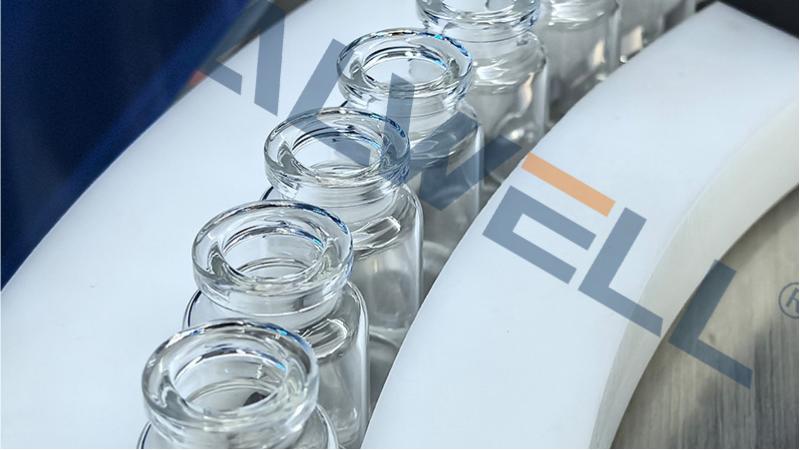
Filling
The servo-driven metering system (ceramic piston pump or peristaltic pump) dispenses the preset dose into each vial; vacuum-assisted filling can be applied to suppress bubbles and foaming.
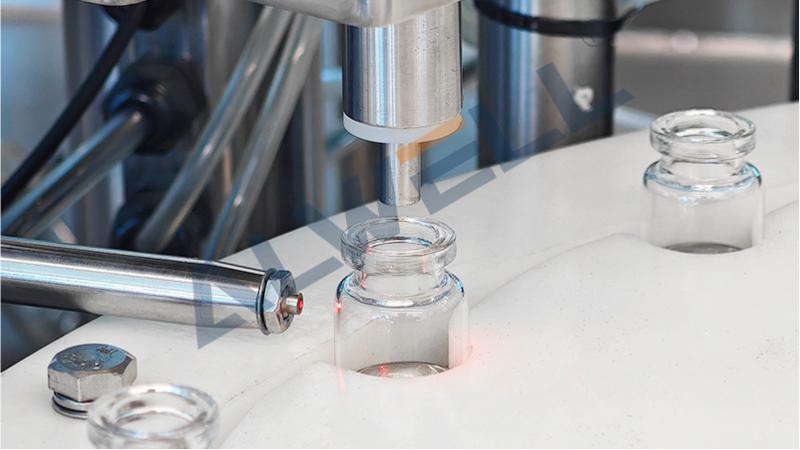
Stopper placement
The stoppering unit presses rubber stoppers onto filled vials; full stoppering or semi-stoppering is available depending on the downstream process (semi-stoppering is used when vials are transferred to a lyophilizer).

Capping (if configured)
Where the capping unit is installed, aluminum caps are crimped onto the stoppered vials to complete sealing. If the capping module is not selected, stoppered vials are discharged for off-line or downstream capping.

Finished vial discharge
Sealed vials are discharged to the outfeed conveyor for transfer to inspection and packaging.

Technical Specifications
|
Item |
Specification |
|
Machine name |
Vial filling and sealing machine |
|
Applicable materials |
Liquid (water-based) or powder, depending on configuration |
|
Filling range |
0.1–30 ml (metering pump replaced per volume range) |
|
Number of filling heads |
1–2 (customizable) |
|
Filling accuracy |
±1% |
|
Production capacity |
1,500–3,000 vials/hour (customizable) |
|
Stoppering pass rate |
≥99.8% |
|
Capping pass rate |
≥99.8% (when capping unit is configured) |
|
Applicable vial size |
customizable |
|
Stoppering method |
Automatic stopper placement; full or semi stopper (selectable) |
|
Capping method |
Aluminum cap rolling (optional module) |
|
Environment |
Class 100 laminar airflow with aseptic operation glove box |
|
Machine material |
SUS304 frame; product-contact parts SUS316L + medical-grade silicone |
|
Total power |
Approx. 3 kW |
|
Voltage |
380 V, 50 Hz |
|
Compressed air |
0.6–0.7 MPa |
|
Equipment noise |
≤70 dB |
|
Overall dimensions |
2,800 × 1,900 × 2,400 mm (including laminar flow unit) |
|
Machine weight |
Approx. 500 kg |
Applications
Applications of Vial Filling Equipment
The machine is specified by product family, because viscosity, oxygen sensitivity and closure method decide the pump type and the stoppering mode. The categories below are ones the platform is built and configured for; anything outside them should be raised with engineering before it is quoted.
| Product type | Typical dose | Dosing and closure configuration |
|---|---|---|
| Injectable solutions and small-volume parenterals | 1 – 20 ml | Ceramic piston pump, full stoppering, capping |
| Water for injection and saline-type diluents | 5 – 30 ml | Ceramic piston pump, full stoppering |
| Vaccines (including viral vector and mRNA platforms) | 0.5 – 10 ml | Ceramic piston or peristaltic pump, full stoppering |
| Biological products - mAbs, proteins, GLP-1 and insulin formulations | 0.5 – 10 ml | Low-shear dosing, peristaltic pump for single-use paths |
| Medical aesthetics - hyaluronic acid, collagen, gel-type injectables | 0.5 – 10 ml | Rotary piston or high-viscosity pump, full stoppering |
| Ophthalmics and eye drops | 0.5 – 10 ml | Ceramic piston pump, full stoppering |
| Diagnostic reagents and veterinary injectables | 1 – 30 ml | Ceramic piston pump, full stoppering |
| Sterile dry powder and lyophilised products | 0.1 – 30 ml equivalent | Auger screw dosing for powder; half-stoppering for lyophilisation |
Lyophilized products are filled with semi-stoppering and then transferred to a separate freeze-dryer; the lyophilization step itself is performed by dedicated freeze-drying equipment, not by this machine.
Production Line Integration
Vial Filling Line and Optional Equipment
A typical vial filling line built around this machine consists of the following stages:
Bottle unscrambler → Ultrasonic vial washer → Hot-air circulation depyrogenation tunnel → Vial filling and stoppering machine (this machine, capping optional) → Inspection → Packaging

|
Line position |
Equipment |
Supplied by |
|
Vial feeding |
Bottle unscrambler |
ALWELL |
|
Washing |
Ultrasonic vial washer |
ALWELL |
|
Sterilization / depyrogenation |
Hot-air circulation tunnel oven |
ALWELL |
|
Filling + stoppering (+ optional capping) |
Vial filling and sealing machine |
ALWELL (core machine) |
|
Capping (standalone) |
Vial capping machine |
ALWELL (optional, if not integrated) |
|
Lyophilization |
Freeze dryer |
Third-party interface - ALWELL machines provide semi-stoppered vial discharge and docking |
|
Inspection |
Vial inspection machine |
Optional |
|
Conveying |
Inter-machine conveyors |
Typically third-party or integrator-supplied |
Customization
Vial Filling Machine Configuration Options
The machine can be configured per project across the following dimensions:
- Vial format - adapted to customer vial types and sizes; changeover parts adjusted accordingly.
- Filling volume - 0.1–30 ml, with the metering pump selected/replaced for the target dose range.
- Filling heads - 1 or 2 heads standard; other configurations customized to capacity needs.
- Capacity - 1,500–3,000 vials/hour as standard; higher-throughput requirements can be addressed with ALWELL's rotary vial filling platforms (from 12,000 up to 36,000+ vials/hour) for large-scale production.
- Stoppering / capping - full stopper or semi-stopper (for lyophilization); capping module optional.
- Automation level - standalone operation or full-line integration with upstream washing/sterilization and downstream inspection/packaging.
- Dosing technology - ceramic piston pump or peristaltic pump for liquids; auger (screw) dosing for powders; vacuum-assisted filling for bubble-sensitive or viscous products.
Products Description
Why Choose ALWELL for Vial Filling Solutions
1.Focused manufacturing experience - ALWELL (Shanghai ALWELL Machinery Equipment Co., Ltd., founded 2013) is a national high-tech enterprise specializing in small-dose filling solutions, with 15+ years of industry experience, a 5,000 m² manufacturing facility. Multiple R&D achievements hold national patents, and machines are exported to Europe, the Americas, the Middle East, and Southeast Asia.
2. Compliance-oriented design - machines are built to GMP/cGMP requirements with SUS304 structure, SUS316L product-contact parts, medical-grade silicone fluid paths, Class 100 laminar protection, and servo-controlled operation. ALWELL holds CE certification, and its quality system is aligned with ISO and FDA aseptic production expectations.
3.Factory testing before shipment - each machine undergoes comprehensive performance testing and simulated filling before delivery, so customers receive equipment verified against their process parameters.
4.Project delivery process - ALWELL follows a structured workflow: requirements definition → solution confirmation → commercial agreement → manufacturing → delivery, with solution design support from the initial consultation stage.
5.Installation, commissioning, and training - on-site installation and commissioning, plus operator and maintenance training, are part of ALWELL's end-to-end support.
6.Documentation support - GMP-oriented design documentation is available to support customer qualification activities
7.Spare parts and after-sales service - ALWELL provides lifelong maintenance support and spare parts supply, with one-to-one service. Factory visits, including a VR factory tour, can be arranged.

One-stop Vial filling machine Factory in China
Please tell me your specific needs and we will provide you with the most suitable filling solution.
FAQ
Q: Which vial types and sizes can the machine handle?
A: The machine is adapted to customer-specific vial formats through changeover parts and configuration. Please provide your vial diameter, height, and dose volume so we can confirm compatibility and quote the correct configuration
Q: Can it fill both liquids and powders?
A: Yes - liquid filling uses ceramic piston or peristaltic pumps, and powder dosing is available in a dedicated auger (screw) configuration. For a specific powder product, we will confirm feasibility based on powder characteristics before quoting.
Q: What is the production capacity?
A: The standard configuration delivers 1,500–3,000 vials per hour and can be customized. For high-volume production, ALWELL offers rotary vial filling platforms reaching 12,000–36,000+ vials per hour.
Q: What filling accuracy can be achieved?
A: Filling accuracy is ±1%, supported by servo-driven ceramic piston or peristaltic pump metering. Vacuum-assisted filling is available for bubble-sensitive and viscous products.
Q: How are stoppering and capping performed?
A: Stopper placement is automatic with a plugging pass rate of ≥99.8%, and either full stoppering or semi-stoppering (for lyophilization downstream) can be selected. Capping is an optional module that rolls aluminum caps with a pass rate of ≥99.8%; if not selected, stoppered vials are discharged for capping elsewhere.
Q: Can the machine run in aseptic / sterile production?
A: Yes. The machine is designed for aseptic operation with Class 100 laminar airflow, an aseptic operation glove box, SUS316L product-contact parts, and GMP-oriented construction. Specific sterile configurations (e.g., RABS or isolator integration) should be discussed per project.
Q: Can it be integrated into a complete filling line?
A: Yes. The machine docks with ALWELL ultrasonic vial washers, hot-air circulation depyrogenation tunnels, bottle unscramblers, and downstream equipment, and ALWELL supports whole-line layout and integration planning.
Q: What is the delivery lead time?
A: Lead time depends on the configuration (filling heads, capping, integration scope) and current production schedule. Please contact us with your project requirements for a confirmed delivery date.
Q: What information do you need to prepare a quotation?
A: To quote accurately, please provide: product type (liquid/powder) and characteristics, vial size and material, filling volume, target capacity, stoppering/capping requirements, automation level, and whether line integration is required.
Hot Tags: Vial Filling and Sealing Machine for Pharmaceutical Production, China Vial Filling and Sealing Machine for Pharmaceutical Production manufacturers, suppliers, factory, Prefilled Syringe Filling Machine, Syring Filling Machine, syringe filling machine


